

A child who checks her mother’s face before answering a simple question may not be shy, because she may live with a narcissistic mother, and the adults around her can change how that childhood feels.

How a Narcissistic Mother Shows Up in a Child’s Daily Life
The term narcissistic mother describes a pattern of behavior, not a diagnosis. Only a licensed mental health professional can diagnose narcissistic personality disorder (NPD). The Mayo Clinic describes NPD as a condition with an inflated sense of importance, a deep need for admiration, and trouble with empathy. Many mothers who act this way never get a diagnosis. This article uses the phrase “narcissistic mother” the way parents, teachers, and therapists use it in everyday talk: a mother whose need for admiration and control regularly outweighs her child’s needs.
Psychotherapist Karyl McBride wrote about this pattern in her 2008 book Will I Ever Be Good Enough? Her work helped many adult children name what they lived through. New parents, teachers, and grandparents see the signs in small moments:
- Praise depends on performance. A narcissistic mother may glow after a trophy and go cold after a bad grade. The child learns that love is a prize, not a gift.
- Feelings get dismissed. The child cries, and the mother says, “You’re too sensitive” or “Stop making a scene.”
- The child manages the mother’s mood. The child reads her face, her tone, and the sound of her keys in the door.
- Privacy disappears. The mother reads diaries, shares embarrassing stories in public, or speaks for the child.
- Image outranks the child. The family looks perfect on social media while the child feels invisible at the dinner table.
Here is a composite scenario, built from patterns teachers often describe. A third-grade teacher hands back a quiz with a B+. A girl named Maya bursts into tears. The teacher says, “This is a good grade.” Maya whispers, “My mom will say I embarrassed her.” Maya does not fear the grade. She fears her mother’s reaction to it. A teacher who sees this pattern does not need to diagnose anyone. She only needs to notice that the child’s fear is bigger than the situation.
Grandparents often notice a different sign. A grandson stops talking whenever his mother enters the room. He hands over his toy the moment she says she wants it. He apologizes for things he did not do. These behaviors tell you the child has learned that peace costs him his own needs.
Remember that a single bad day does not make a narcissistic mother. Every parent snaps, forgets, or loses patience. The pattern matters: it repeats over months and years, and the child pays for it. If you see it, your job is simple. You stay steady, because a child with a narcissistic mother needs at least one adult who behaves the same way every day.

Disciplining the Child Without Copying a Narcissistic Mother’s Playbook
Discipline in a home with a narcissistic mother often follows her mood, not the child’s behavior. The same spilled juice earns a laugh on Monday and a screaming fit on Tuesday. She may use shame (“What is wrong with you?”), the silent treatment, or public embarrassment. Children cannot learn rules from this, because the rules keep changing. They only learn to watch for danger.
Developmental psychologist Diana Baumrind studied parenting styles in the 1960s and 1970s. Her research on authoritative parenting, which combines high warmth with clear limits, links this style to better outcomes for children than harsh or permissive styles. You can use this approach whether you are a new parent, a teacher, or a grandparent. Here is how.
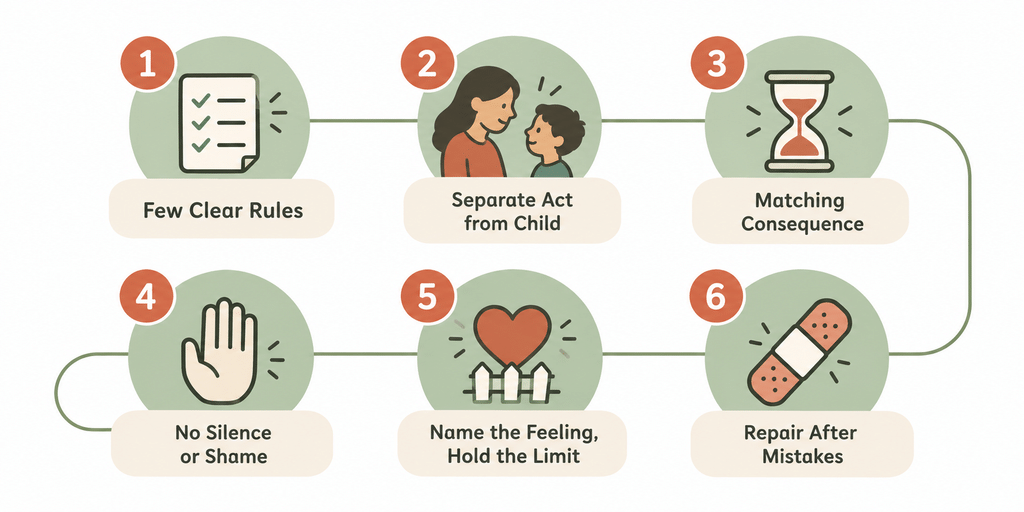
1. Keep the rules few, clear, and the same every day.
Pick three to five rules. Say them in plain words: “We use gentle hands. We clean up our toys. We tell the truth.” A child who grew up with a narcissistic mother needs predictability more than most children. When the rules stay the same, the child’s body can relax.
2. Separate the act from the child.
Say, “Hitting hurts. I will not let you hit,” not “You are a bad boy.” A narcissistic mother often attacks who the child is. You can attack the behavior and still protect the child’s worth.
3. Match the consequence to the act.
If a child throws a block, the block goes away for ten minutes. If a child scribbles on the wall, the child helps wipe it. Keep consequences short, calm, and related to what happened. Skip the long lecture. Skip the threat you will not carry out.
4. Never use silence or shame as a tool.
The silent treatment teaches a child that love can vanish without warning. If you need a break, say so: “I am upset. I will take five minutes and then we will talk.” Then come back. Your return teaches more than any lecture.
5. Name the feeling and hold the limit.
Psychologist John Gottman describes this approach as emotion coaching. You accept the feeling and limit the behavior. For example: “You are angry that screen time ended. You can stomp your feet or squeeze a pillow. You cannot throw the tablet.” A child who got called “too sensitive” at home hears something new: feelings are allowed, and actions have limits.
6. Repair after you make a mistake.
You will lose your temper sometimes. When you do, go back and say, “I yelled earlier. That was not okay. I am sorry.” A narcissistic mother rarely models this skill. When you repair, you show the child that adults can admit mistakes and that relationships survive them.
Consider a second composite scenario. A grandmother named Rosa watches her seven-year-old grandson, Dev, after school. At his mother’s house, Dev never knows which version of his mother will appear. At Rosa’s house, the rules never change: shoes by the door, homework before TV, kind words at the table. When Dev breaks a glass, Rosa says, “Accidents happen. Let’s sweep it up together.” Dev stares at her, waiting for the explosion. It does not come. After a few weeks, he stops flinching. Rosa did nothing dramatic. She stayed consistent.
Teachers can do the same with classroom routines. Post the schedule. Give a two-minute warning before transitions. Use the same calm voice for the first mistake and the fifth. A child with a narcissistic mother often performs well in a predictable classroom, because it feels like the one place where the rules make sense.
If you grew up with a narcissistic mother and now parent your own child, watch for your own reflexes. Many adults hear their mother’s voice come out of their mouths. Try a simple pause: stop, breathe once, and ask yourself, “What does my child need right now?” That one breath gives you a chance to choose your response instead of repeating hers.

Loving the Child in Ways a Narcissistic Mother Does Not
Discipline sets limits, and love gives the child a reason to trust them. A narcissistic mother may say “I love you” often, but the child feels the conditions attached. Love that depends on performance, obedience, or making the mother look good does not feel like love. It feels like a job.
You can offer the opposite, and the research supports several concrete habits.
Praise effort and character, not just results.
Psychologists Claudia Mueller and Carol Dweck published a well-known 1998 study with fifth graders. Children praised for intelligence chose easier tasks afterward and did worse after failure, while children praised for effort chose harder tasks and kept trying. For a child whose narcissistic mother measures worth by achievements, this matters a great deal. Say, “You worked hard on that drawing,” or “You were kind to your friend today.” Praise the things the child controls.
Give one-on-one time that asks for nothing.
Spend ten minutes a day with no phone, no teaching, and no fixing. Let the child pick the activity. Build a block tower. Draw. Walk around the block. The message the child receives is: “You matter even when you do nothing impressive.”
Let the child have opinions and feelings.
A narcissistic mother often decides what her child likes, thinks, and feels. Hand the choice back in small ways: “Do you want the red cup or the blue cup?” “What do you think about that story?” Small choices build a self. If a child says “I feel sad,” do not rush to fix it. Say, “Tell me more.”
Be the steady adult.
The Harvard Center on the Developing Child reports that the most common factor in children who develop resilience is at least one stable, committed relationship with a supportive adult. You may be that adult. You do not need to replace the mother. You only need to show up the same way, again and again.
Do not attack the mother in front of the child.
Children love their parents, even hurtful ones. When you criticize a narcissistic mother in front of her child, the child often feels torn and defends her. Many child therapists advise against it for this reason. Instead, keep your statements short and true: “Your mom is having a hard time with her feelings. It is not your fault, and I am here.” Share more detail as the child grows older and asks questions.
A third composite scenario shows how this works. A first-grade teacher notices that a boy named Arjun never shows her his drawings. He crumples them before she can look. She does not push. She says, “I like your colors,” once, and leaves it. A week later she says, “I’d love to see what you made, but only if you want to share.” Months pass. One day Arjun hands her a drawing without a word. She says, “Thank you for trusting me with this.” She never mentions his mother. She simply builds a safe corner where his work, and his feelings, count.
New parents who grew up with a narcissistic mother face a harder version of this task. You are learning to give what you never got. Expect it to feel awkward. You may feel guilty when you set a limit, or uneasy when you praise your child’s effort. Those feelings are normal. They show you are doing something different, not that you are doing something wrong.

Practical Steps for Parents, Teachers, and Grandparents
Each role has its own tools. Use the ones that fit your place in the child’s life.
For new parents who grew up with a narcissistic mother:
- Get your own support. Many adults who grew up with a narcissistic mother find that therapy helps them spot old patterns. Attachment researchers use the term “earned security” for adults who build healthy relationships despite a difficult childhood. It is not automatic, but it is possible.
- Set limits on contact. You can protect your child without cutting off your mother completely. For example, you can keep visits short, stay in the room, and leave when she mocks, shames, or ignores your rules.
- Keep your parenting plan simple. Write down three values you want your child to feel at home, such as honesty, kindness, and safety. When you feel pulled into old habits, return to the list.
- Do not ask your child to take sides. Do not use your child as a messenger or as emotional support about your mother.
For teachers:
- Watch patterns, not single events. Note when a child shows fear out of proportion to the situation, over-apologizes, or freezes after praise. Write down dates and facts, not guesses.
- Do not diagnose the mother or accuse her. You will lose the parent’s trust and may make things worse for the child. Describe what you see in the classroom: “Maya cried when she saw her quiz. I wanted to share that and ask how we can support her.”
- Bring in the school counselor. Counselors have training you may not have, and they can connect the child with services.
- Know your reporting duties. If you suspect abuse or neglect, follow your school’s child protection policy and your local law. A narcissistic mother may act in painful ways without crossing the legal line, but if you see signs of physical harm, threats, or a child who talks about hurting himself, you must report right away.
For grandparents:
- Keep your home predictable. Your house may be the one place where the child knows what happens next. Protect it.
- Talk to your adult child with care. If the narcissistic mother is your daughter or daughter-in-law, direct confrontation often backfires. Use short, calm, factual statements: “Dev did well at dinner. He ate all his vegetables.” Share the child’s strengths and avoid debates about her parenting.
- Do not compete for the child’s loyalty. If you criticize the mother or buy the child’s affection with gifts, the child will feel the tug-of-war. Offer steady time instead.
- Know your limits. If the mother cuts off your access, you may feel grief and anger. A family therapist or a grandparent support group can help you stay steady for the day the child reaches out.
For everyone:
- Act on safety first. If a child faces physical harm, threats, or talks about self-harm, contact your local child protection service or crisis line immediately. A narcissistic mother’s behavior may hurt a child emotionally for years, but danger to a child’s body or life always comes first.
- Expect slow progress. A child who spent years scanning for danger will not relax in a week. Trust builds through small, repeated moments, such as a calm answer to a mistake, a promise you keep, or a question you ask and truly listen to.
- Take care of yourself. You cannot offer steadiness on an empty tank. Sleep, talk to a friend, and ask for help when you need it.
No one can erase the effects of a narcissistic mother, and no adult needs to be perfect. You need to be consistent, kind, and present. Over time, a child who learned that love must be earned can learn that it is simply there.
A narcissistic mother may shape a child’s first lessons about love, but she does not write the last chapter. Every steady adult who sets a calm limit, praises real effort, and keeps a promise adds a line to a better story.