

Children do not need perfect parents, but they do need adults who work as a team, and co parenting is how separated families build that team.
Build Co Parenting on One Shared Goal
Co parenting means two adults raise one child together, even though they live apart or disagree. It covers divorced parents, separated parents, and parents who never lived together. Many families also bring in stepparents, grandparents, and teachers, so co parenting often grows into a small team.
Research gives a clear reason to try. Psychologists Robert Emery and Paul Amato have both reported that ongoing, open conflict between parents hurts children more than the separation itself. Kids do not need their parents to be friends. They need the fighting to stop. That finding shapes every good co parenting plan.
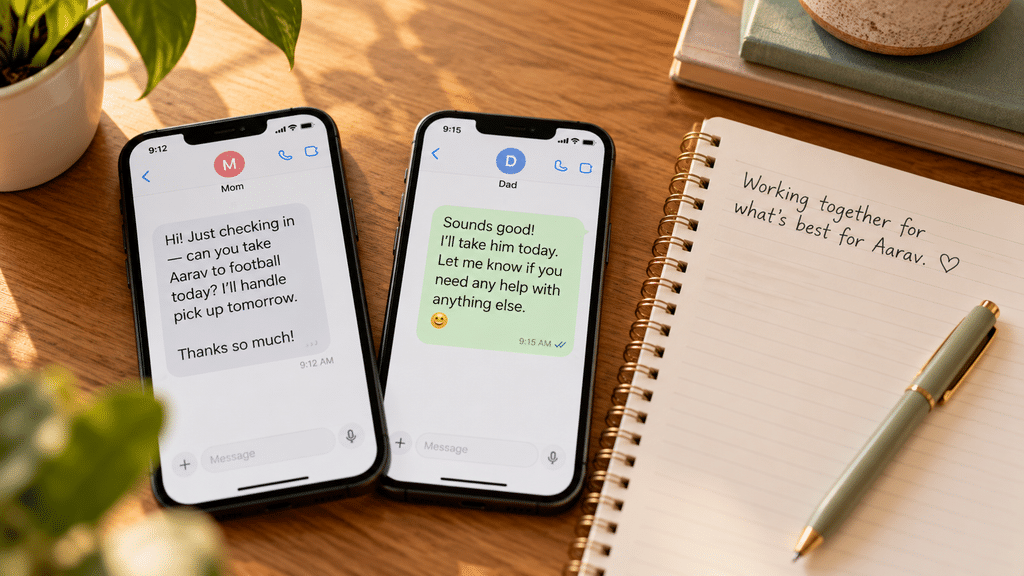
Start your co parenting plan with one sentence that both parents accept. For example: “Our daughter feels safe, loved, and clear about the rules in both homes.” Write it down and save it in your phone notes. When an argument starts, read the sentence and ask one question: does this move help her, or does it help me win? Share the sentence with grandparents and teachers too, so everyone in your co parenting circle pulls in the same direction.
Next, change how you talk to the other parent. Treat the relationship like a work partnership. Bill Eddy, a lawyer and therapist who founded the High Conflict Institute, teaches the BIFF method for tough messages: keep each one Brief, Informative, Friendly, and Firm. Compare two texts:
“You always forget his shoes. Do you even care?”
“Please send his soccer shoes on Thursday. Practice starts at 4:00.”
The second text invites a yes. The first text starts a fight. Use the BIFF style in every co parenting message for one month, and watch how the replies change.
Finally, decide what you must agree on and what you can let go. Agree on the big items: health care, school, safety, a bedtime range, and screen limits. Let go of small differences, such as which vegetable shows up at dinner or how each parent folds laundry. Children handle two different homes well when the core rules match. A healthy co parenting plan does not copy every detail; it protects the few rules that matter. In co parenting, you pick your battles, and you pick fewer of them. Co parenting is a skill, and skills improve with practice.
Set Co Parenting Rules That Match in Both Homes
Kids test rules, and they test harder when two homes send two messages. A child who hears “no tablet at dinner” at Mom’s house and “sure, go ahead” at Dad’s house learns to ask the softer parent. That is not bad behavior. It is smart behavior. Good co parenting closes that loophole.
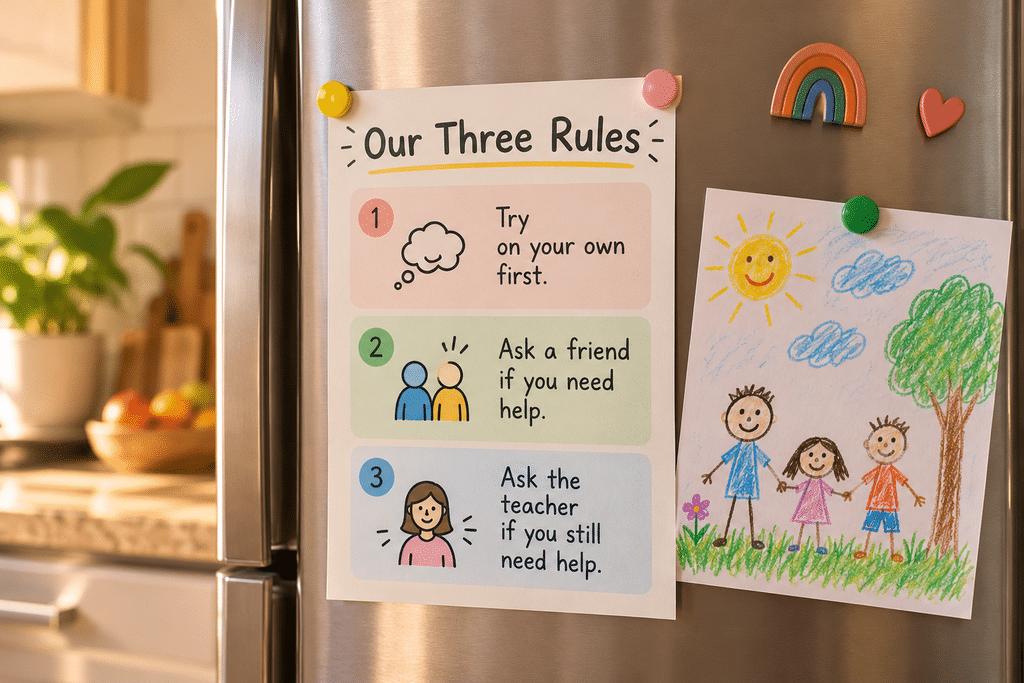
Try the three-rule method. Both parents sit down once, in person, on a call, or with a mediator, and pick three non-negotiable rules. Examples: we speak kindly, we finish homework before screens, we go to bed by 8:30 on school nights. Then agree on one consequence for each rule. Keep consequences short and linked to the behavior. If a child throws a toy, the toy goes on a shelf for the day. If a child skips homework, screens wait until the work is finished. Three clear co parenting rules beat twenty rules that nobody remembers.
Write the rules into a one-page co parenting agreement, even if no court requires it. Post a copy in both homes at your child’s eye level. Review it every six months, because a rule that fits a five-year-old rarely fits a ten-year-old. Update the co parenting agreement together as your child grows.
Here is a composite example of co parenting in action. Maya, age 6, hit her brother during a busy handoff day. Her mother used a calm time-in: she sat with Maya, named the feeling (“You felt angry”), and asked Maya to say sorry and help get an ice pack. That evening, she texted Maya’s father: “Maya hit Ben today. We used the calm-down corner and a sorry. Please repeat the same steps if it happens again.” The next weekend, he did. Maya met the same response in both homes, so waiting for the “easier” house gained her nothing. Notice the pattern: one short update, one shared response, no blame.
The American Academy of Pediatrics advises parents to avoid spanking and harsh verbal punishment, and to use calm, consistent discipline instead. That advice fits co parenting well, because consistency matters most when a child moves between homes.
Praise counts as discipline too. Catch good behavior in each home, and name the action: “You packed your own bag. That helps our team.” Specific praise teaches more than a quick “good job.” When both parents praise the same habits, the child learns which habits matter. Strong co parenting pairs clear rules with warm praise.
Handle disagreements about discipline in private. If you think the other parent’s consequence is too harsh, do not argue in front of your child. Send a message later: “I saw Max lost screens for a week. I think one day fits better. Can we talk Sunday?” Ask a question; do not make an accusation. A child who watches parents settle differences calmly learns how adults solve problems, and that lesson may be the best gift co parenting can give.

Show Love in Two Homes, Not in Competition
Discipline keeps children safe, and love makes them want to follow the rules. Children in two homes often carry a quiet worry: “Is it okay to love both of them?” Co parenting works best when each parent answers that worry out loud. Tell your child, “You can love Dad, and you can love me. Neither one costs the other.”
Never use your child as a messenger. Do not send notes, money, or complaints through your child, and do not quiz your child about the other home. Ask open questions instead: “What was the funniest thing at school today?” Healthy co parenting keeps children out of the middle.
Handoffs trip up many children, so keep them short, calm, and predictable. Use the same time, the same place, and a small ritual, such as a snack or a favorite song in the car. Let a comfort item, like a stuffed animal or blanket, travel with the child. For younger children, a picture calendar shows when they will see the other parent again. Smooth handoffs anchor any co parenting schedule.
Plan birthdays and holidays early. Split them fairly or alternate years, and tell your child the plan weeks ahead. Surprises about holidays hurt. Calm co parenting around special days gives a child memories without tension.
Tools can lower the pressure. Apps such as OurFamilyWizard and TalkingParents, or a shared Google Calendar, keep schedules, expenses, and messages in one place. Some courts recommend them. A shared calendar also leaves a clear record, which cuts down on “I never agreed to that” arguments. Pick one tool for your co parenting communication and stick with it.
Luis offers a second composite example. He sees his son every other weekend and cannot attend Tuesday soccer games. He asks his ex-wife to record a short clip. Each Friday, father and son watch the clip together, and Luis asks about the best play. He shows love by showing interest in the part of his son’s life he misses. His ex-wife helps by sending the clip without comment. That is co parenting at its simplest: each adult gives the child access to the other adult.
Speak about the other parent the way you want your child to speak about you. Even a sigh or an eye roll lands. If you feel angry, vent to a friend, a counselor, or a journal, not to your child. One important limit: if abuse or neglect worries you, different rules apply. Talk to a lawyer or a child-protection service, because every co parenting plan assumes both parents keep the child safe.

Bring Teachers and Grandparents Into Your Co Parenting Team
Children spend most of their week with adults beyond their parents. Those adults can steady co parenting or shake it. Teachers see the child five days a week. Grandparents often step in on weekends and in emergencies.
Teachers, start with fairness. Ask for contact details for both parents, and send the same update to each, at the same time. Stay neutral, and do not carry stories from one home to the other. Report facts, not guesses: “Sam seemed tired this week” helps more than “Sam must be struggling at his dad’s.” Follow any custody papers the school has on file. When teachers keep both parents equally informed, they support co parenting without taking sides.
Grandparents, you hold real influence, because children trust you. Back the rules both parents set, even when you would do things differently. Keep your opinions about the breakup away from the grandchild. Offer practical help: school runs, a calm dinner, a quiet table for homework. Treat both sides of the family with equal warmth. Grandparents who do this give co parenting a steady anchor.
New parents, start early. Babies cannot say what they need, so agree on feeding, sleep, and medical routines in writing. Share a notebook or app and update it at each handoff. Co parenting habits are easier to build before bad patterns form.
Sometimes co parenting stalls. When messages turn hostile, consider parallel parenting: each parent runs their own home, communication stays in writing, and handoffs happen in a neutral place such as school. Family mediators describe this as an option for high-conflict families. It is not a failure. It is still co parenting, built for a hard season, and it protects the child while tempers cool.
Get help early. Mediators, family therapists, and parenting classes such as Children in the Middle, which some courts require, teach practical skills. Your child’s pediatrician or school counselor can point you to local services. Asking for help does not mean your co parenting plan failed; it means you take it seriously.
Co parenting does not ask you to like the other parent; it asks you to put your child’s steadiness ahead of your pride. Start today with one shared sentence, one shared rule, and one calm text.